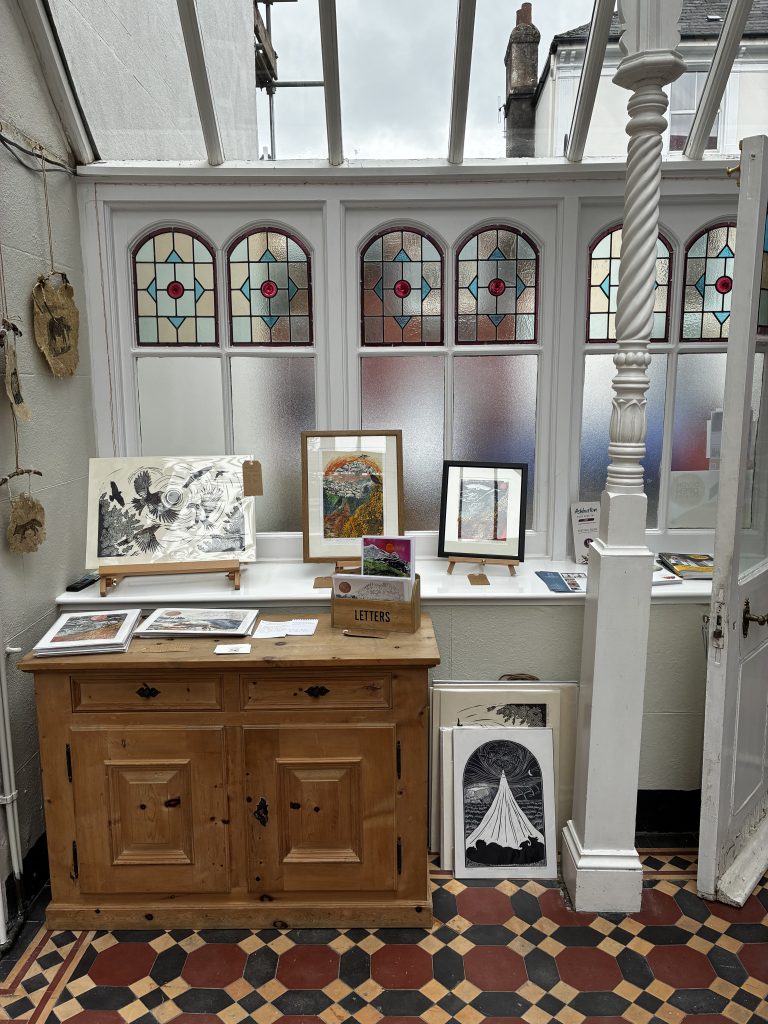
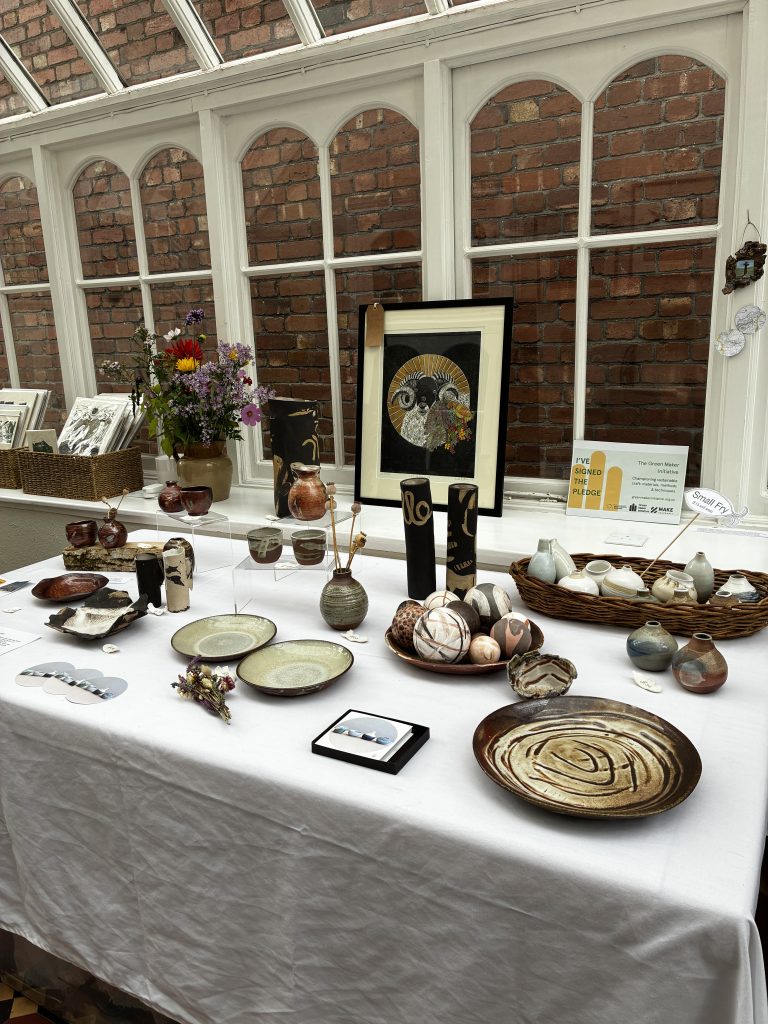
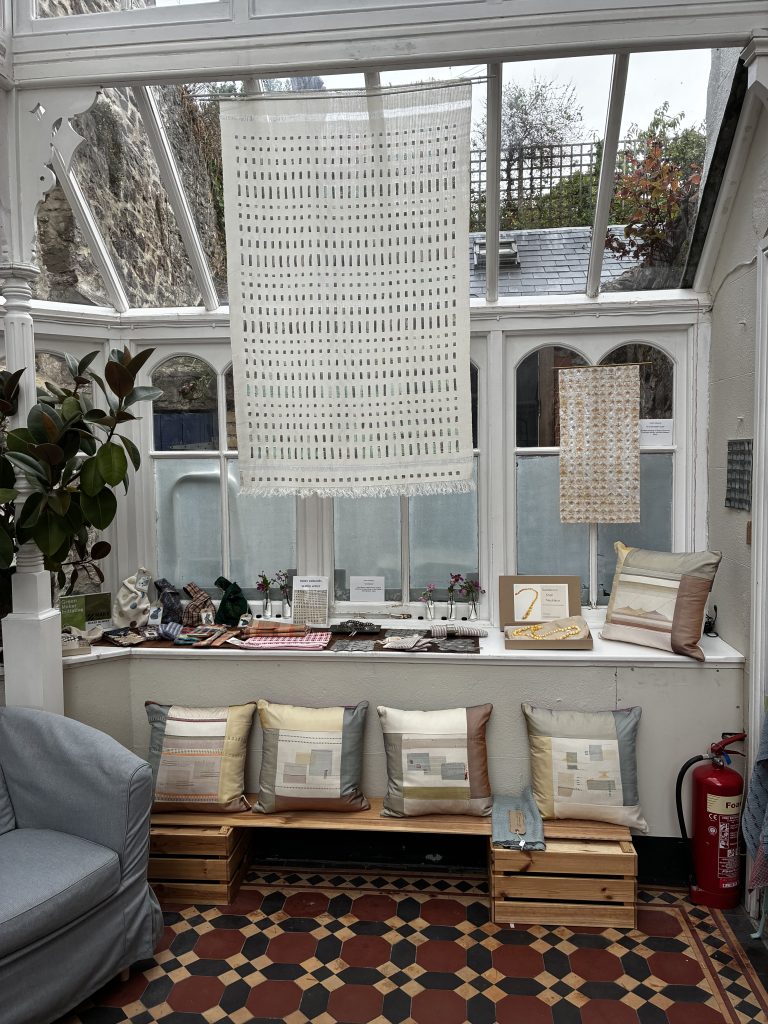
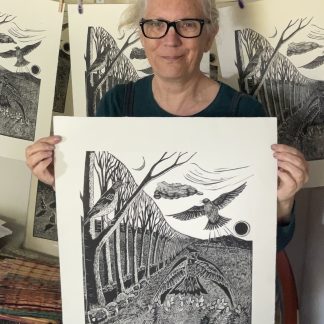
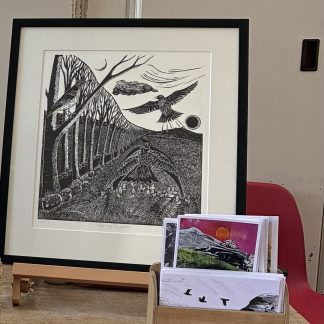
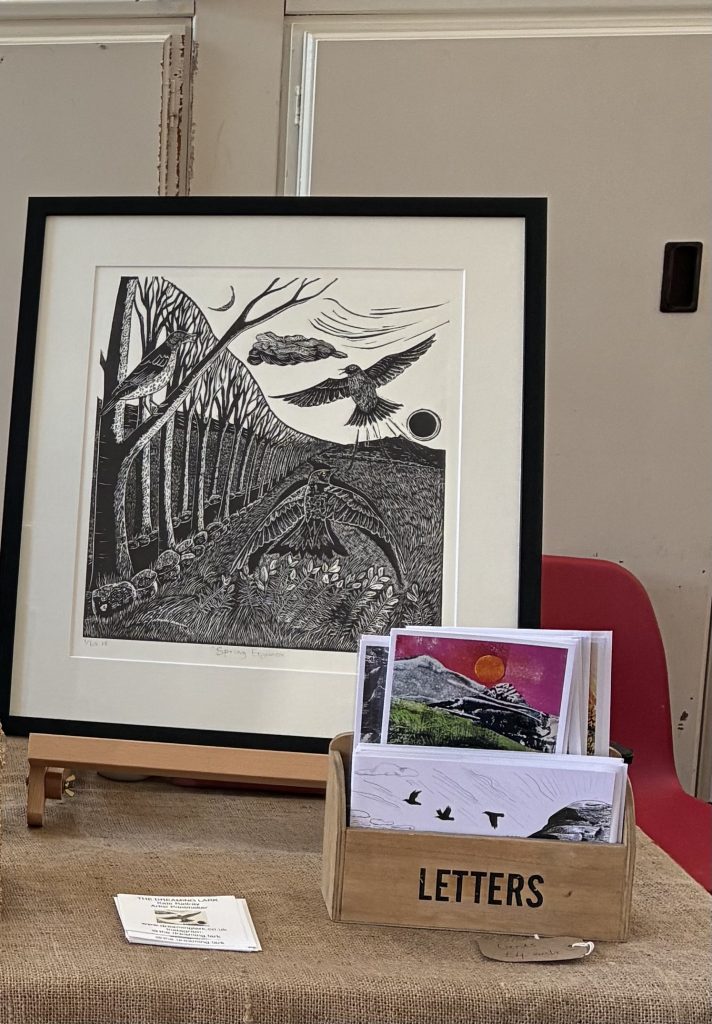
I formed a little group for DOS 26 . Together with two other artists , Helen Edwards (textiles) and Paula Wilson (ceramics) we are showing our work at the Orangery, Ashburton Court bed and breakfast. We are Open every day (10.30 – 4.30) until Sunday 20th September 2026.
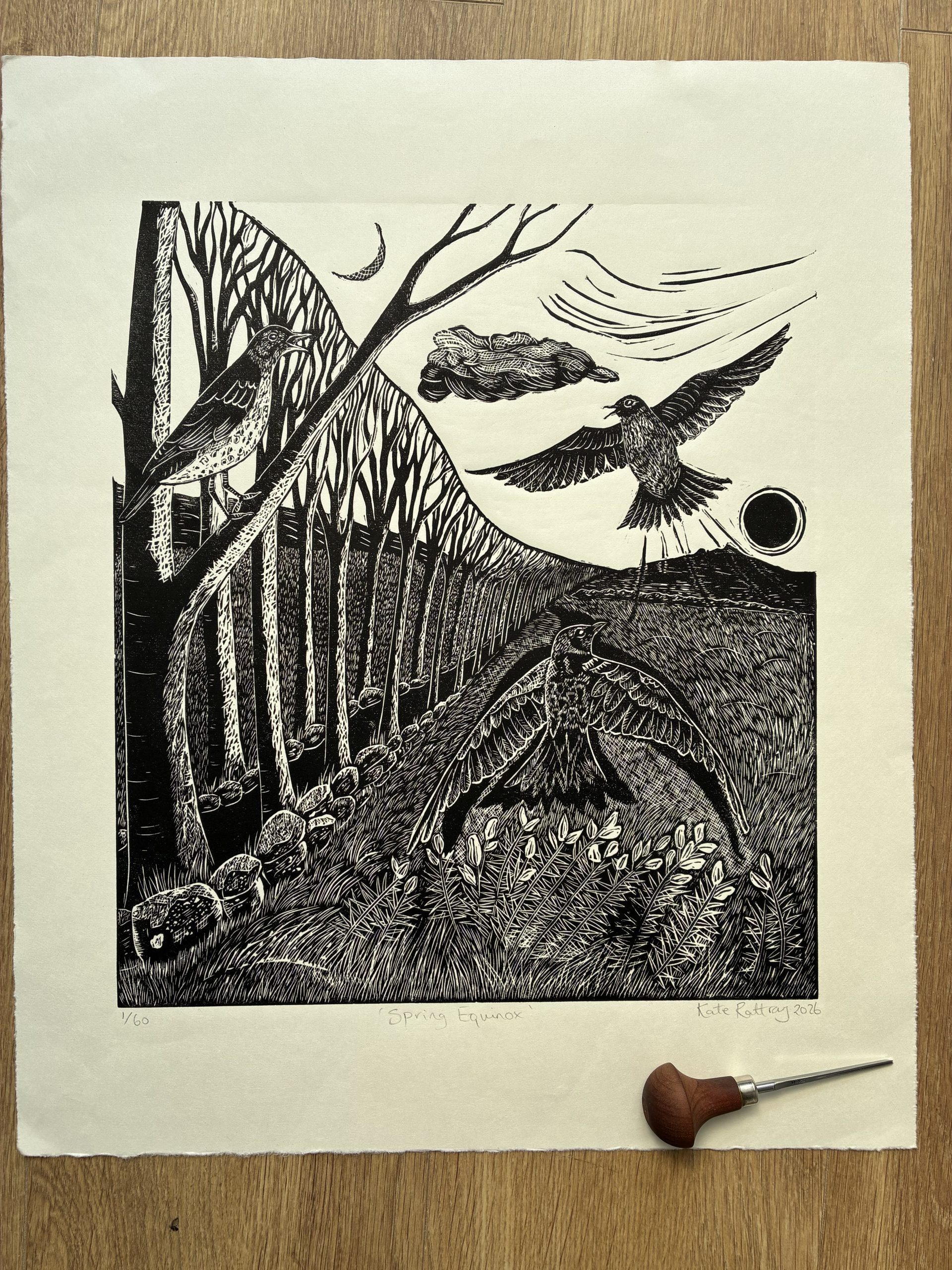
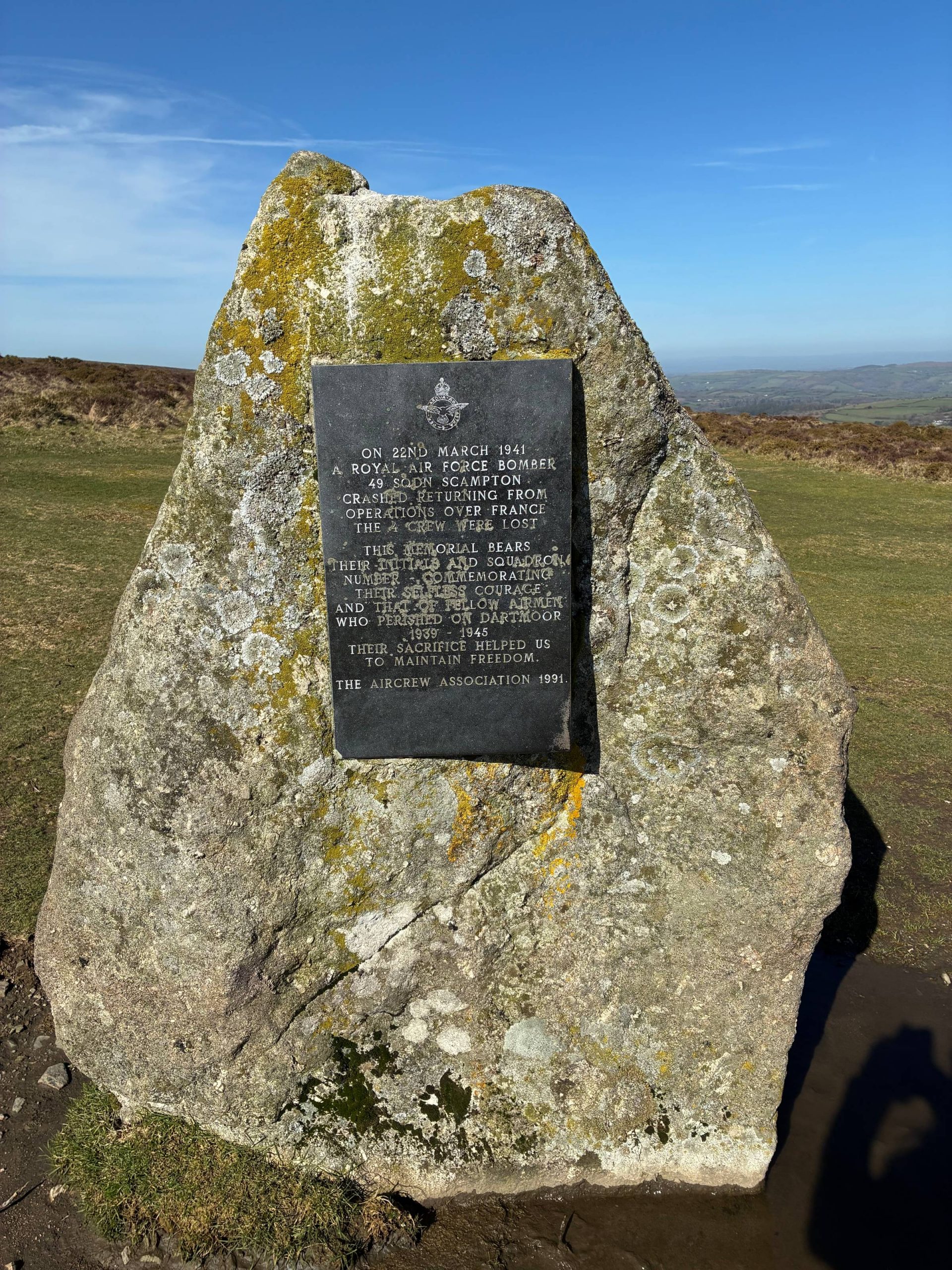
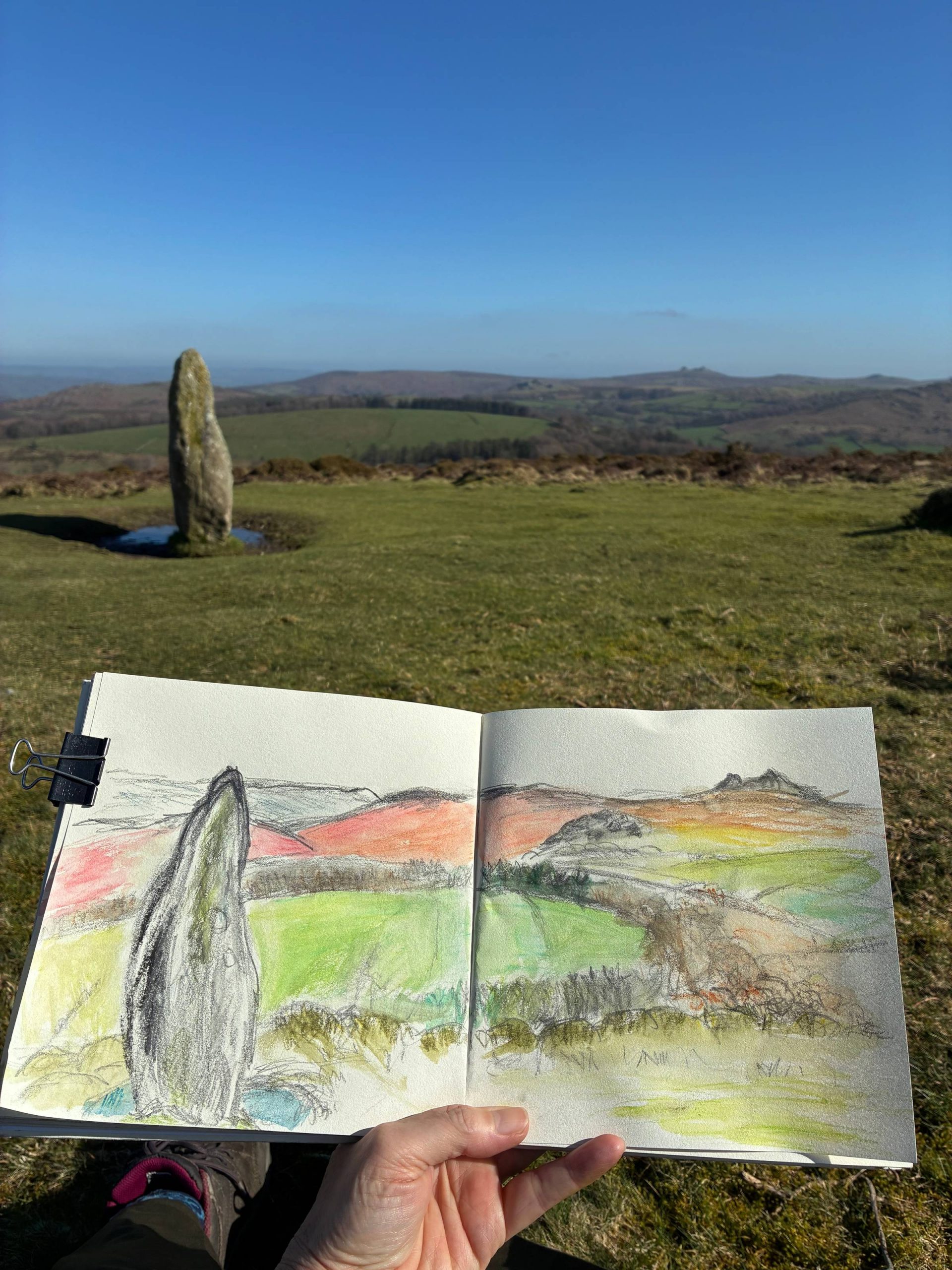
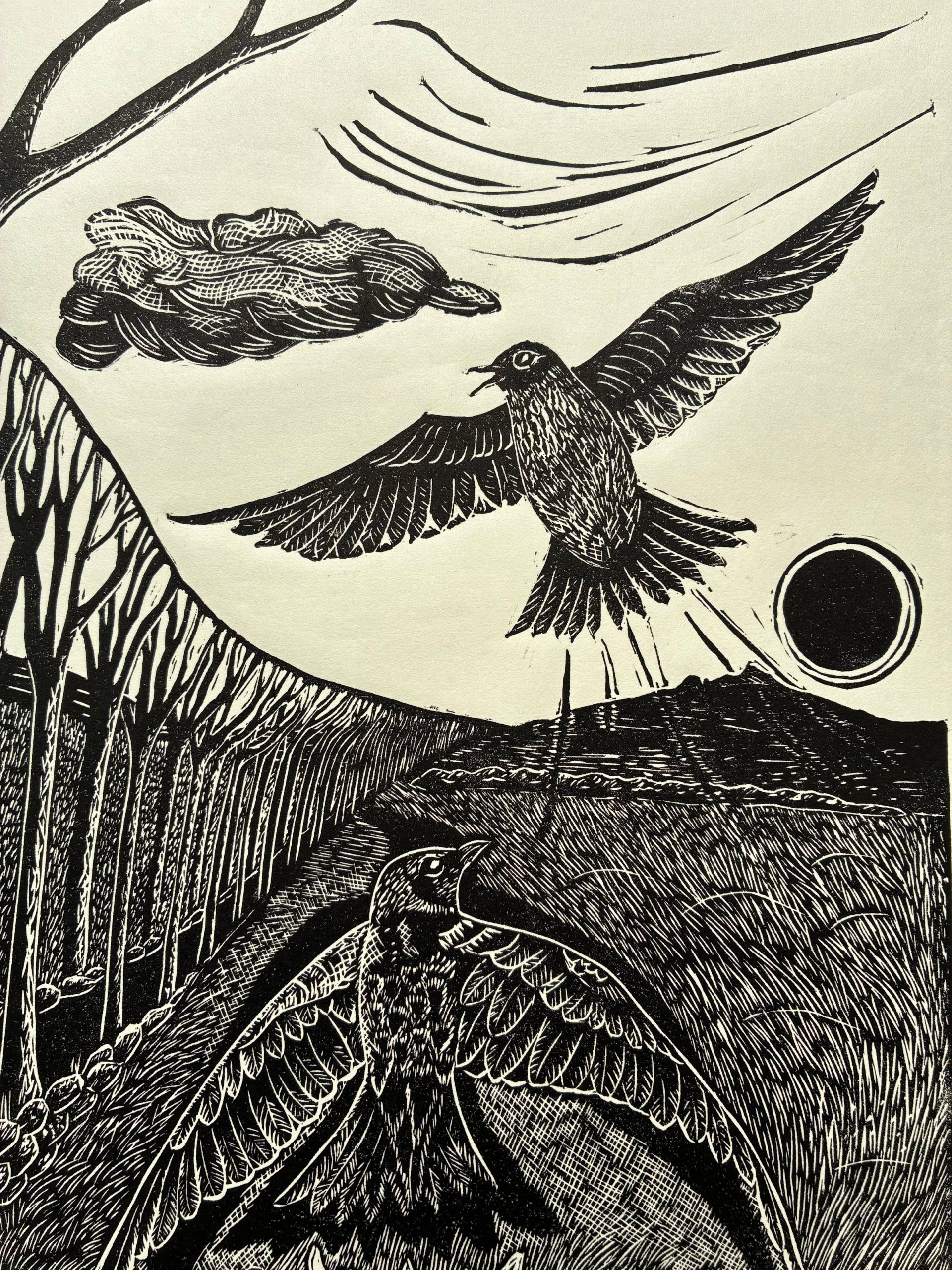
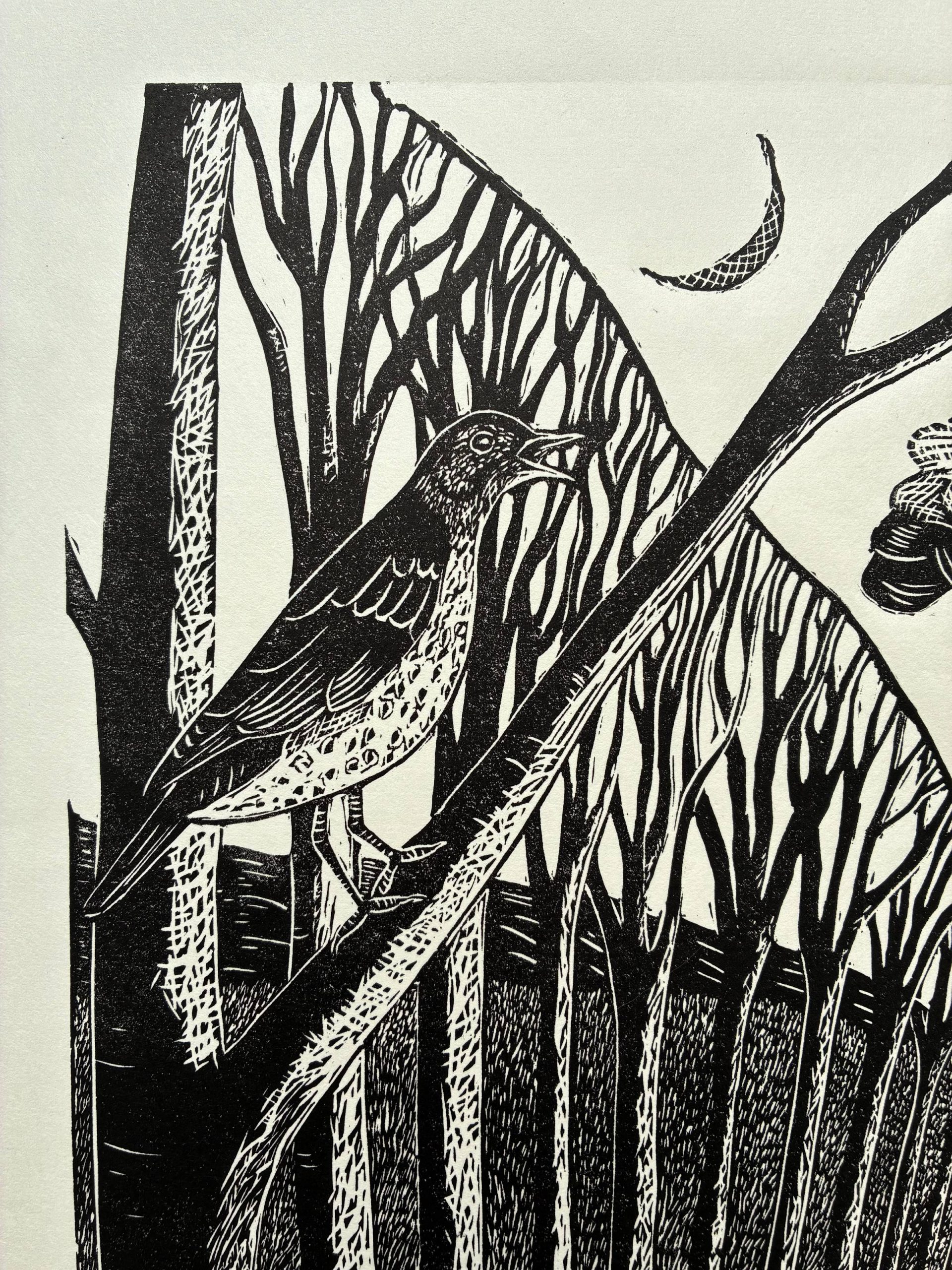
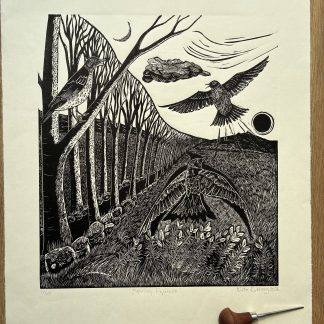
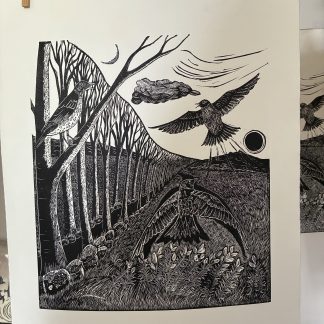
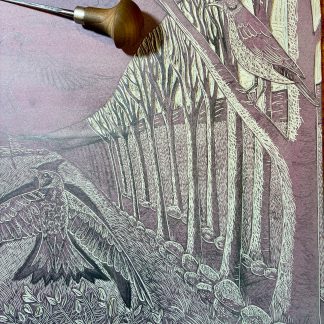
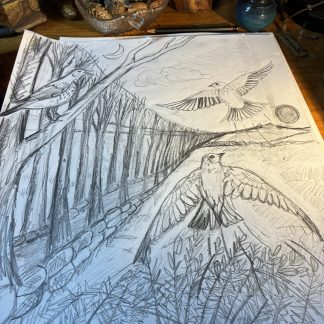
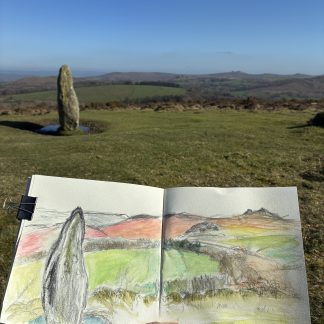
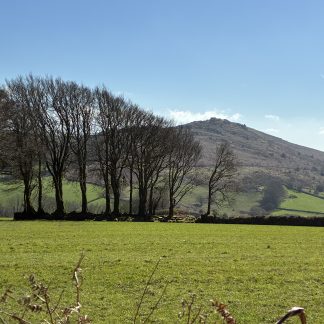
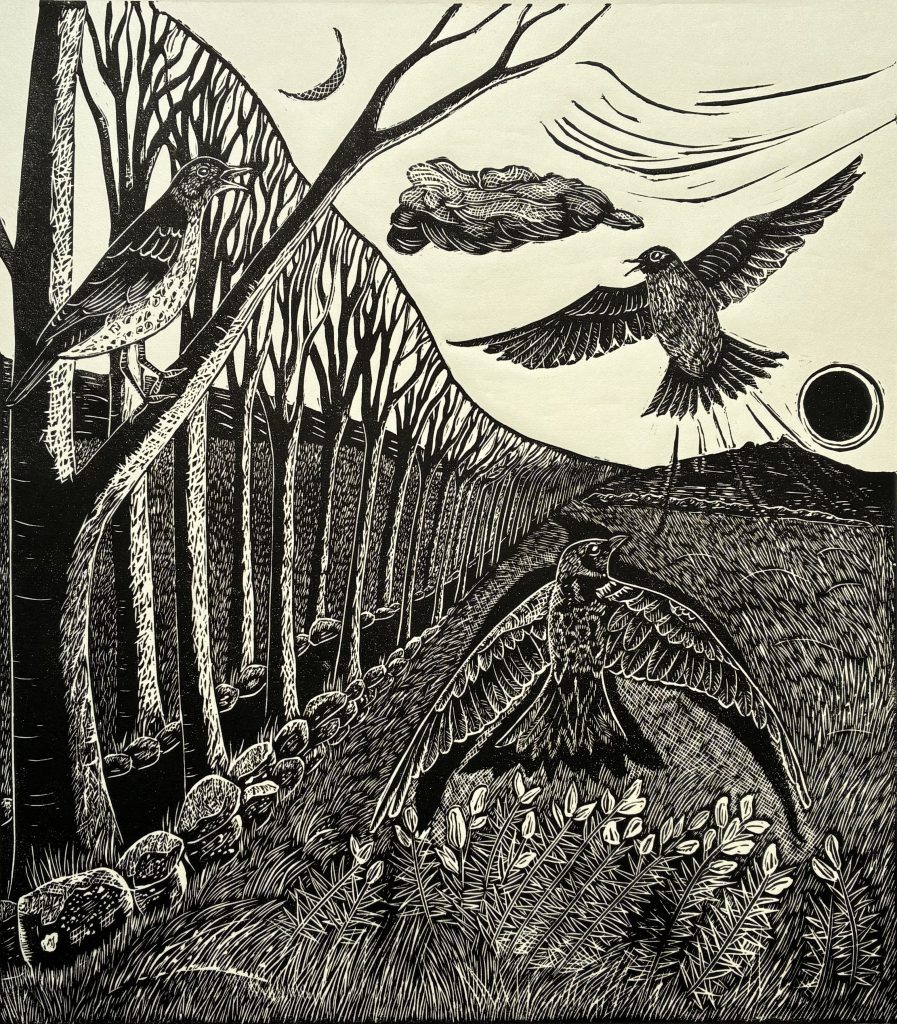
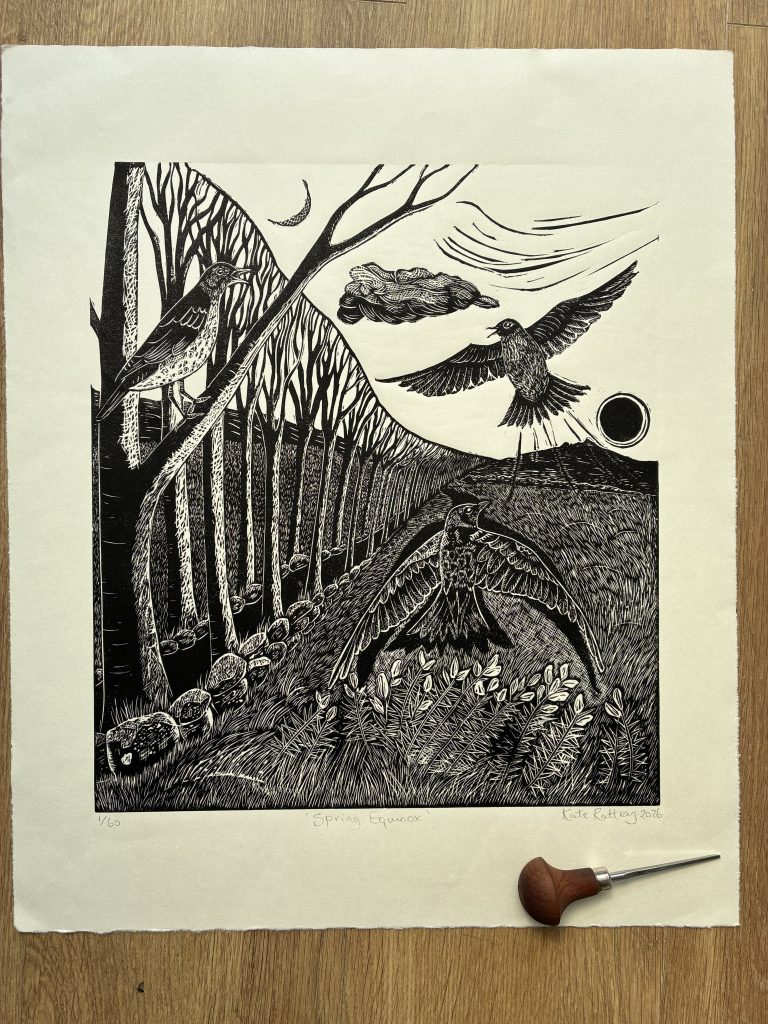
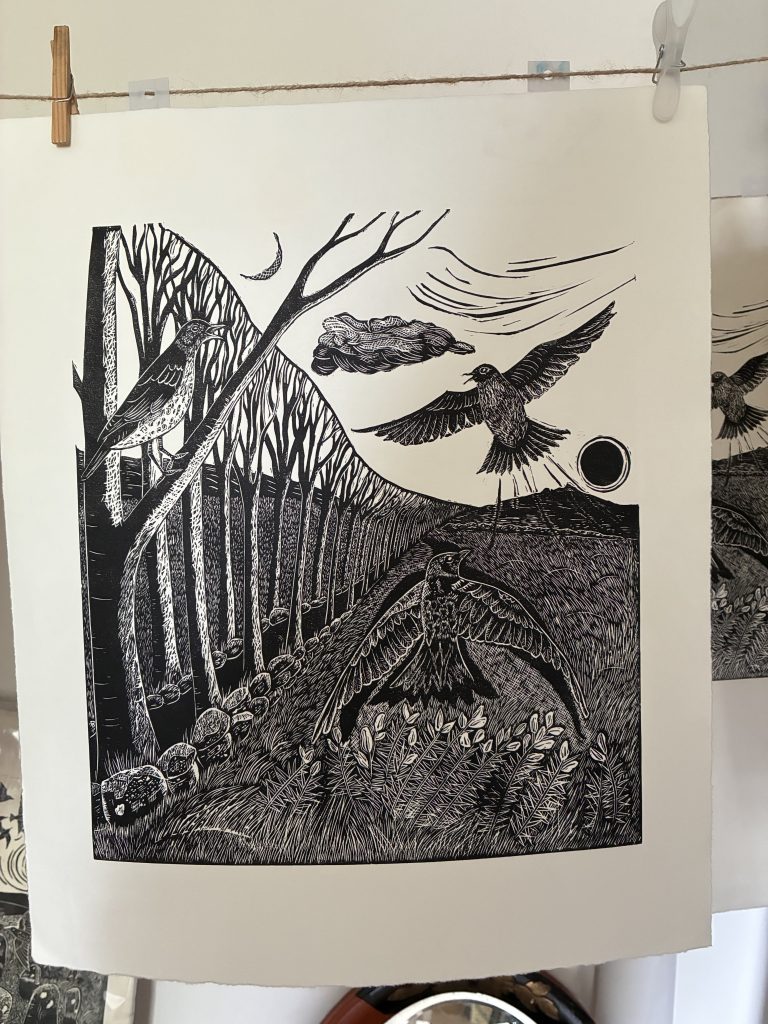
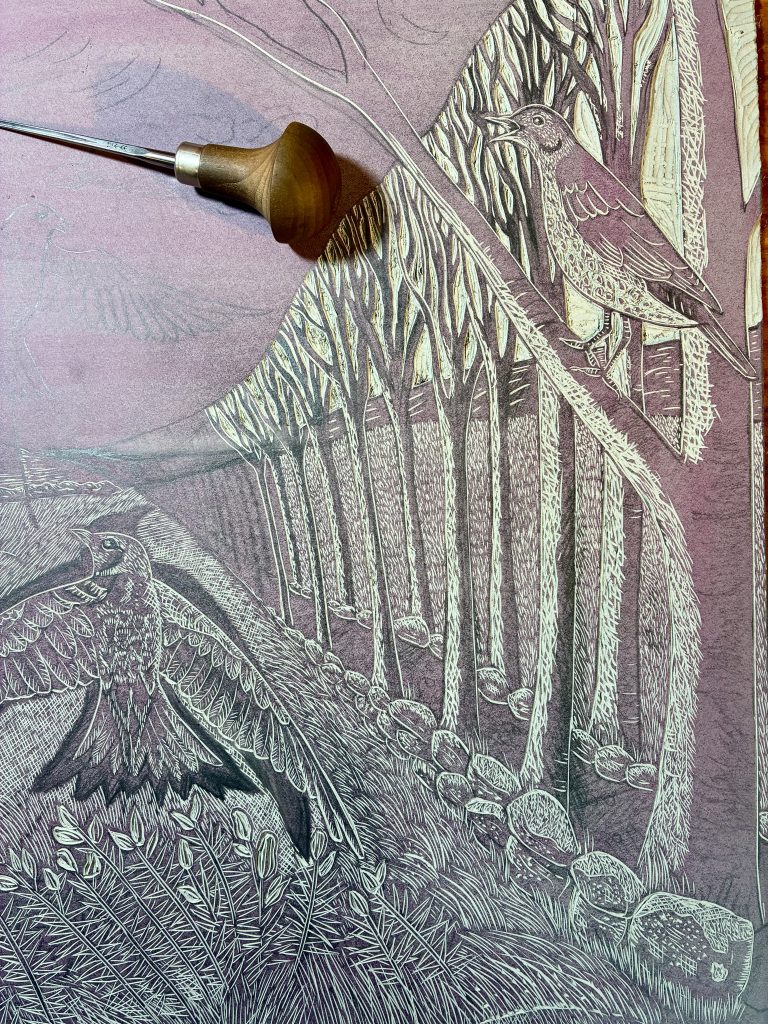
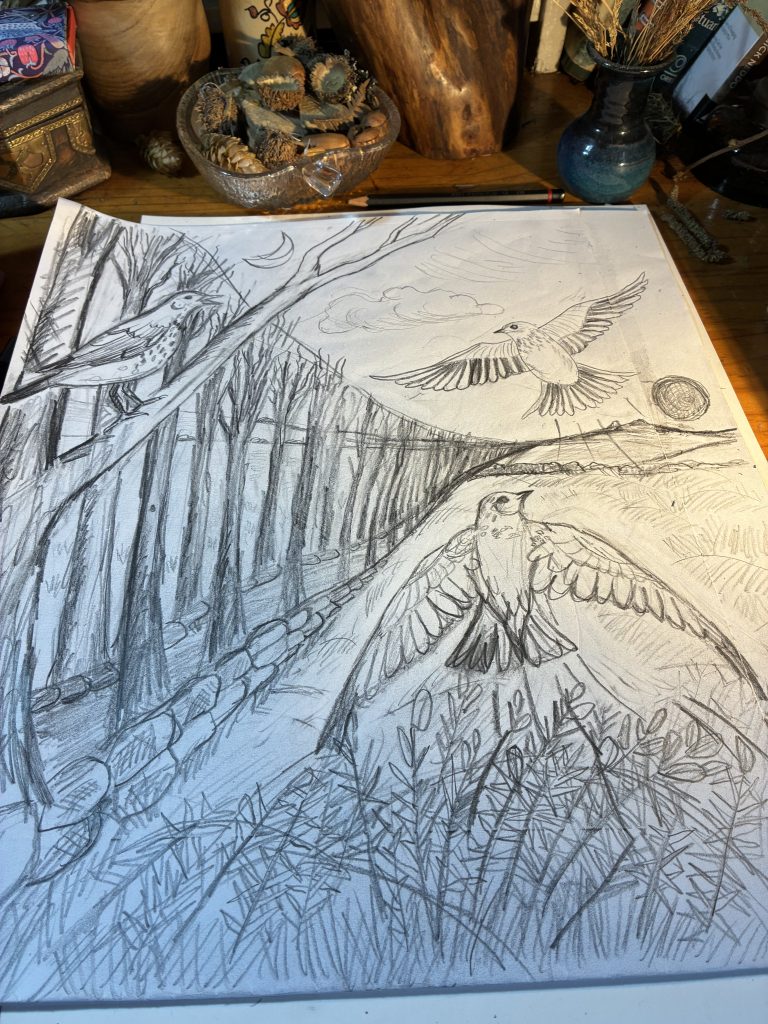
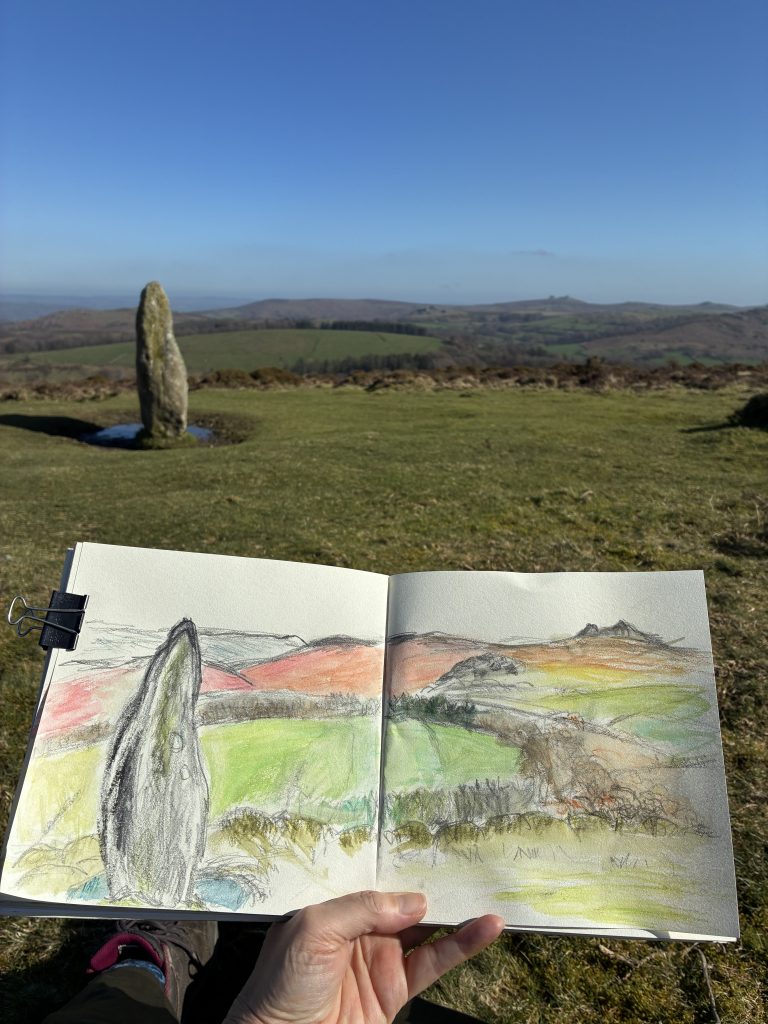
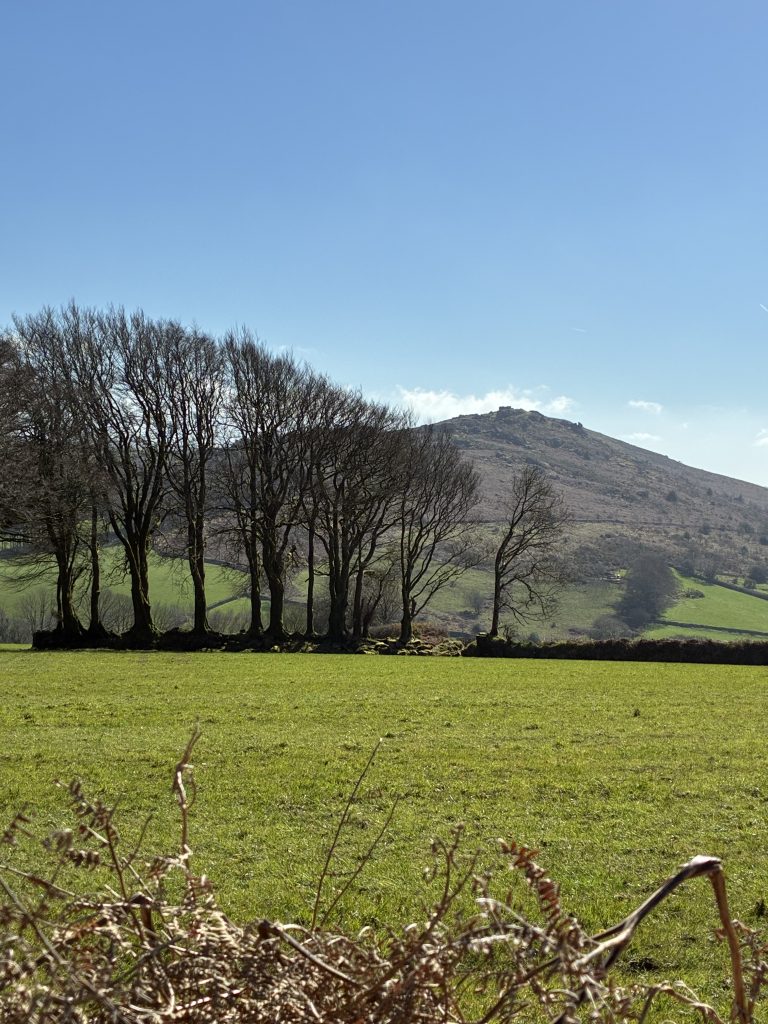
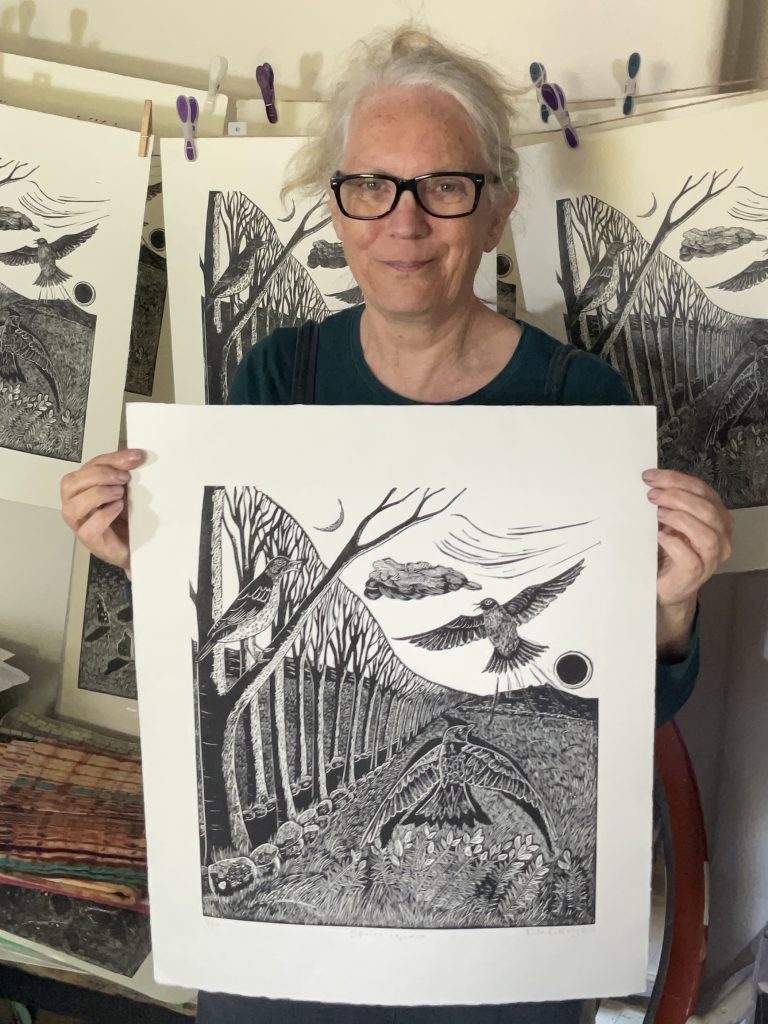
My new print was inspired by a walk I had 48 hours before Spring Equinox which took me from Houndtor, past Jays Grave, onto the old tree lined track and up onto Hameldown. Near the top there’s a memorial stone dedicated to RAF bomber 49, squadron Scampton. Returning from operations in France in 1941, the plane crashed here killing 3 of the crew, the following day the pilot also died.
A tragic and sad day for their friends and families, the unfortunate and devastating price of war.
It’s difficult to move on from tragic stories such as these to something more joyous but life is a roller coaster, is it not? We live in an uncertain world of war and climate change, and at times like these people turn to god, or nature, or folklore.
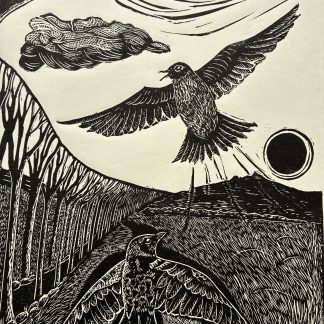
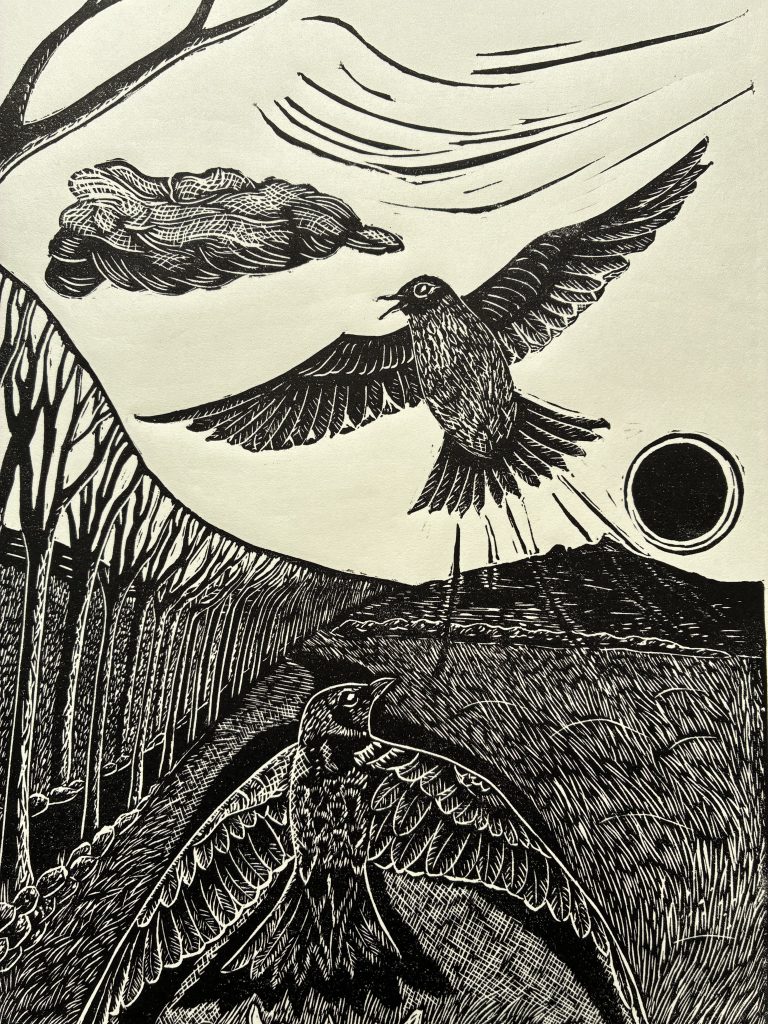
On 18th March this year I sat listening to the skylarks singing their hearts out as they rose from the ground – it’s likely they did the same thing on that fated day in 1941.
They shoot up into the sky and hover, climbing higher and higher so you can only see a speck in the blue, if you can see them at all. Their song is polyphonic, just one bird appears to sing a song that sounds like a whole chorus of birds. It’s a song that reminds me of the gorse, the sweet smelling bright yellow flowers and the big dark green thorns.
Larklore
The lark appears to represent joy, heralding the spring, the new light of dawn and the last light of sunset. It’s not hard to understand why, and Romantic poets such as Wordsworth, Shelley, Blake and Clare all wrote poems about them.
Blake saw the lark as a messenger between heaven and earth, he not only wrote poems about larks but illustrated several of 17th Century John Milton’s works including the poem ’Night Startled by the Lark’
Earlier still, Shakespeare wrote about the lark more than 25 times in his plays and sonnets…
“…the lark at break of day arising
From sullen earth, sings hymns at heaven’s gate”.
(Sonnet 29)
In Romeo and Juliet, there is a reference to a folktale about how it changes its eyes with the toad.
Juliet knows when the lark sings the night with Romeo will end so she detests the lark…
“It is the lark that sings so out of tune, Straining harsh discords and unpleasing sharps. Some say the lark makes sweet division. This doth not so, for she divideth us. Some say the lark and loathèd toad changed eyes. O, now I would they had changed voices too, Since arm from arm that voice doth us affray, Hunting thee hence with hunt’s-up to the day. O, now begone. More light and light it grows.”
Romeo and Juliet (Act III, Scene 5, Line 27)
The hunting reference refers to the start of the day as in the old saying ‘hunt’s up’ which is the same as ‘up with the lark’, although the latter doesn’t suggest you need to kill anything.
Unfortunately like many wild birds, larks were hunted to eat especially during Roman times and later. This quote from Henry V111 references how they were hunted (and eaten) by enticing them with a red rag into a cage.
“Can you endure to hear this arrogance? And from this fellow? If we live thus tamely, To be thus jaded by a piece of scarlet, Farewell, nobility. Let his Grace go forward And dare us with his cap, like larks“
Henry VIII (Act III, Scene 2, Line 338)
Having started this newsletter with a war time memorial I will finish the ‘larklore’ with this poem by Ted Hughes, which says it all with a smack in the face … of course!
The Lark by Ted Hughes
From wrath-red dawn to wrath-red dawn, The guns have brayed without abate; And now the sick sun looks upon The bleared, blood-boltered fields of hate As if it loathed to rise again. How strange the hush! Yet sudden, hark! From yon down-trodden gold of grain, The leaping rapture of a lark. A fusillade of melody, That sprays us from yon trench of sky; A new amazing enemy We cannot silence though we try; A battery on radiant wings, That from yon gap of golden fleece Hurls at us hopes of such strange things As joy and home and love and peace. Pure heart of song! do you not know That we are making earth a hell? Or is it that you try to show Life still is joy and all is well? Brave little wings! Ah, not in vain You beat into that bit of blue: Lo! we who pant in war’s red rain Lift shining eyes, see Heaven too.
detail (larks) of Spring Equinox
Mistle Thrushlore
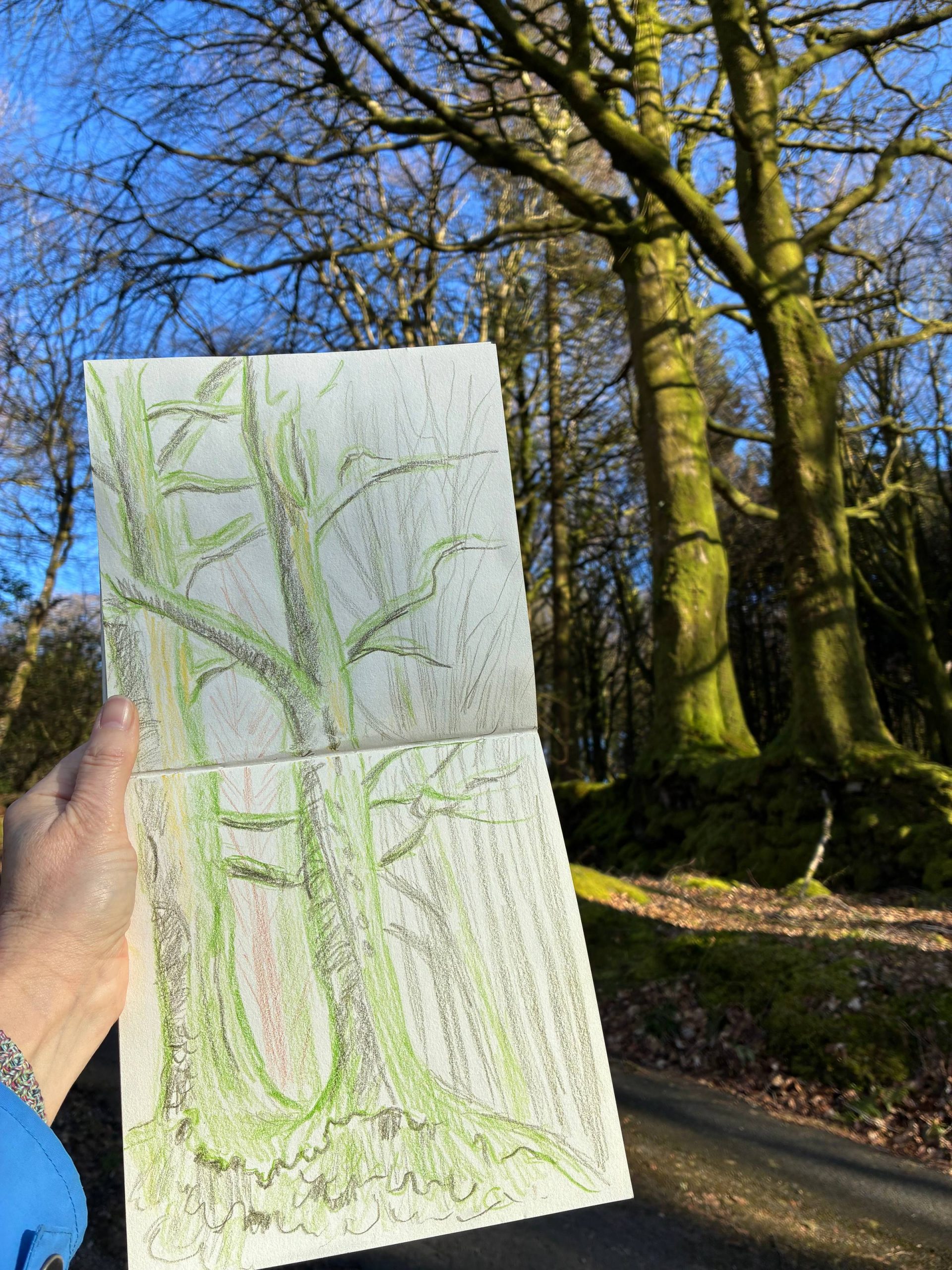
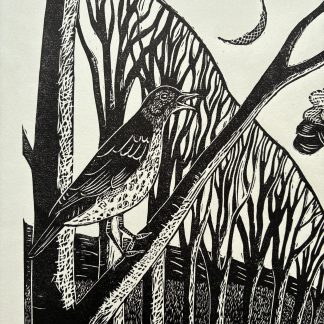
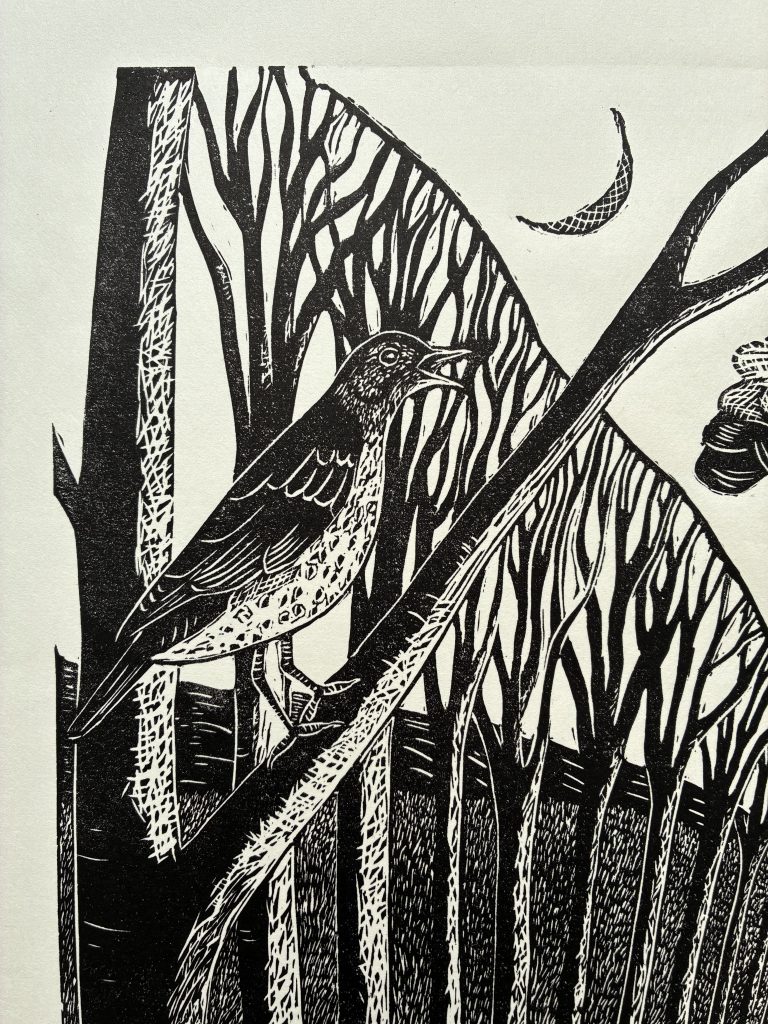
On my way back from Hameldown I walked down through Heathercombe and heard the melancholic call of the mistletoe thrush. Its song is in complete contrast to the lark’s song despite sharing with the lark a two-sided syrinx (the vocal organ) which allows independent sounds on each side.
And it so happens that the syrinx was named after a Greek wood nymph who was pursued by Pan. Syrinx prayed to her sisters of the stream at Ladon who turned her into marsh reeds just at the moment when Pan was about to catch her. As the wind blew through the reeds they made a plaintive sound which Pan loved so much he picked them and made an instrument with wax (which is why Panpipes are so named) so they could always be together.
(This comes from one of the wonderful stories from Ovid’s ‘Metamorphois’)
Heathercombe’s mossy trees
The Mistle Thrush is also a harbinger of spring, sometimes known as a ‘Stormcock’, it is said to call before wet and windy weather. It’s bigger than a song thrush but it doesn’t share the song thrushes melodious repertoire. It repeats one or two same short sad phrases. Other names it has had are the missel thrush, Mizzly Dick and Jeremy Joy and it’s said to be deaf. (that would account for the tuneless song!) Interesting too, our Devon word for light rain is ‘mizzle’.
It is also a fierce defender of its territory. Gilbert White writes:
“The Welch call it ‘pen y llwyn’, the head or master of the coppice. He suffers no magpie, jay, or blackbird, to enter the garden where he haunts; and is, for the time, a good guard to the new-sown legumens.”
from ‘The Natural History of Selborne’ 1789 (p. 153)
The Mistle thrush gets its name from its love of mistletoe berries and spreads the seeds by wiping its beak on the trees, or dispersing them through its droppings.
Mistletoe has its own folklore and associations with magic so the thrush may also be connected with some of these. Perhaps its mournful call can be accounted for as it accompanied Aeneas when he used mistletoe to enter the underworld to visit his father, or perhaps it cries for the death of Norse god Baldr who was killed by blind Hothr with a mistletoe sprig after being encouraged by Loki, after all Baldr was the god of light, joy and the summer sun, (rather like the lark) who wouldn’t lament the loss of him?
There is a European folktale, possibly originating from the Ancient Greeks that the thrush casts off its legs and grows new ones every 10 years.
And finally turning to music, in the song Jack-in-the-Green by Jethro Tull the final lyrics are … “Oh, the Mistle Thrush is coming. Jack, put out the light!”
We are in the time between winter and spring. We have just passed ‘Imbolc’ on February 1st and 2nd , originally a Celtic fire festival to celebrate the forthcoming spring, the return of the light and to honour the goddess / Saint Brigid.
According to Irish folklorist and academic Ó Catháin in his book ‘The Festival of Brigid: Celtic Goddess and Holy Woman’, the folklore associated with Brigid shares links with Shamanic practices of bear cults over 4,000 years ago. Critics find his connections are somewhat tenuous, as he doesn’t present enough evidence to support his theories. I have yet to acquire the book to share my thoughts on the matter, but looking forward to reading about his theories on fire symbolism and connections with bees, oystercatchers, cranes, shellfish, acorns and stones!
It sounds like a wonderful cabinet of curiosities!
However, there are connections that give his theory some gravitas, that being the coming of spring.
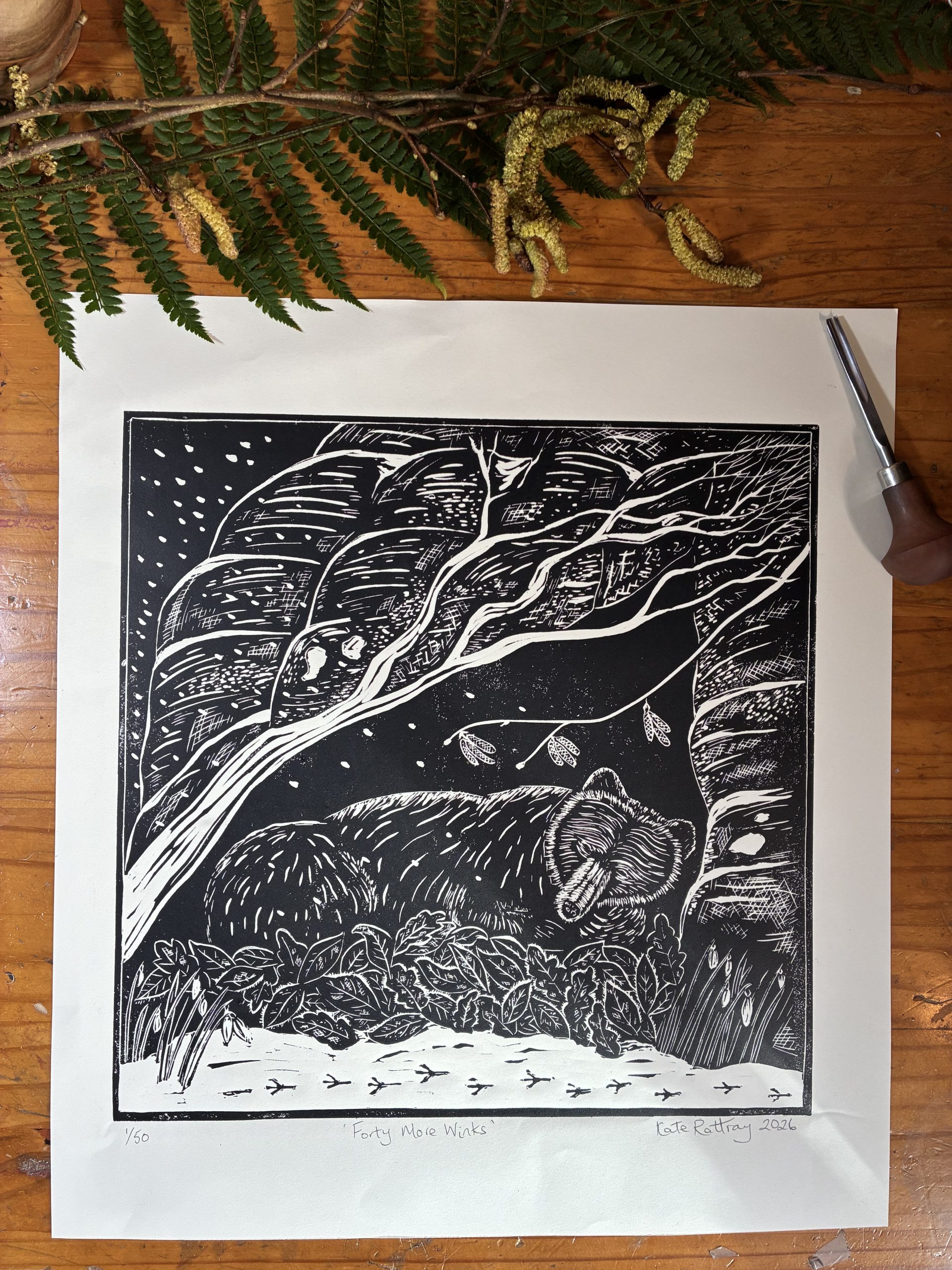
Brigid represents motherhood and fertility, she is nurturing and protective, she is the light and the spring, a symbol of renewal and positivity. These traits are shared by the Celtic great mother bear goddess, known as Artio or Dea Artio, (or any female mother bear at this time of year) who wakes from her winter hibernation in her dark cave, gives birth to cubs and protects them until they are strong enough to go out into the light, the light of Brigid’s ever burning flame. Emerging from the darkness, in some ways the bear’s journey mirrors the shaman’s path—a descent into the hidden realms of the spirit world to return with the gifts of wisdom and enlightenment.
Evidence of Celtic and Gallo Roman bear worship comes to light through ancient carvings and funerary remains found in various locations around the Celtic world like these 5th century BCE sandstone bear statues found at Armagh, and the later Gallo Roman bronze statuette found at Muri bei Bern, Switzerland of the bear goddess standing facing a seated woman with a basket of fruit and a plate. Perhaps she is about to feed the bear, as a form of worship, whereas it’s possible the fruit signifies abundance, another indicator of spring.
In a churchyard in Dacre, Cumberland, stand four stone bears, supposedly Medieval, although it’s debatable, they could be a lot older possibly pre Roman.
In Welwyn Garden City grave, the late Bronze Age remains included ashes of a male human buried with silver cups and pottery vessels (suggesting he was of high status) as well as 6 bear phalanges. Experts indicate that a bear pelt was wrapped around the body before cremation, not only to protect his remains but also to spiritually protect him in his journey to the afterlife or otherworld.
But what about Dartmoor? Were there brown bears on Dartmoor?
It’s very possible. During the Bronze and Iron Ages, Dartmoor would have had more trees in the valley areas than today. Caves would’ve been similar as they are today, set within the rocks and tors, and the climate shifted to a cooler wetter one after the warmer Bronze Age. All perfect conditions for brown bears.
In 2011 archeologists found Bronze Age remains in a cist on Whitehorse hill on Dartmoor. Among them were the cremated ashes of a young person, a basket of jewellery and a bear pelt that covered the remains and wasn’t burnt. The quality of the necklace suggested again that the person was a female of high status, possibly a Celtic princess.
It’s possible these bear pelts were traded from overseas, but further evidence suggests that they were living here in the UK probably from before the ice age right through to around 500CE, when they became extinct due to hunting.
But here’s food for thought, why was the bear pelt wrapped around the body ‘before’ cremation took place at Welwyn but only placed with the ashes ‘after’ cremation at the Whitehorse hill site? Was this a difference between a male and a female burial? Or was it a geographical difference in funerary rites? Or was it not actually wrapped around the man after death but being worn as a garment when he died? If that was the case then why wasn’t the woman wearing hers, did she die in fewer clothes, at night maybe whilst sleeping under her bear pelt? Or did the pelt belong to another, maybe a lover or her father?
Perhaps they believed that by keeping the bear pelt in tact for this princess there would be even more chance of enabling a peaceful transition to the otherworld.
Which brings us back to the start of this post and the significance of the Great Mother Bear goddess.
But I have another burning question, (!!) what happened to the other four bear phalanges at Welwyn?
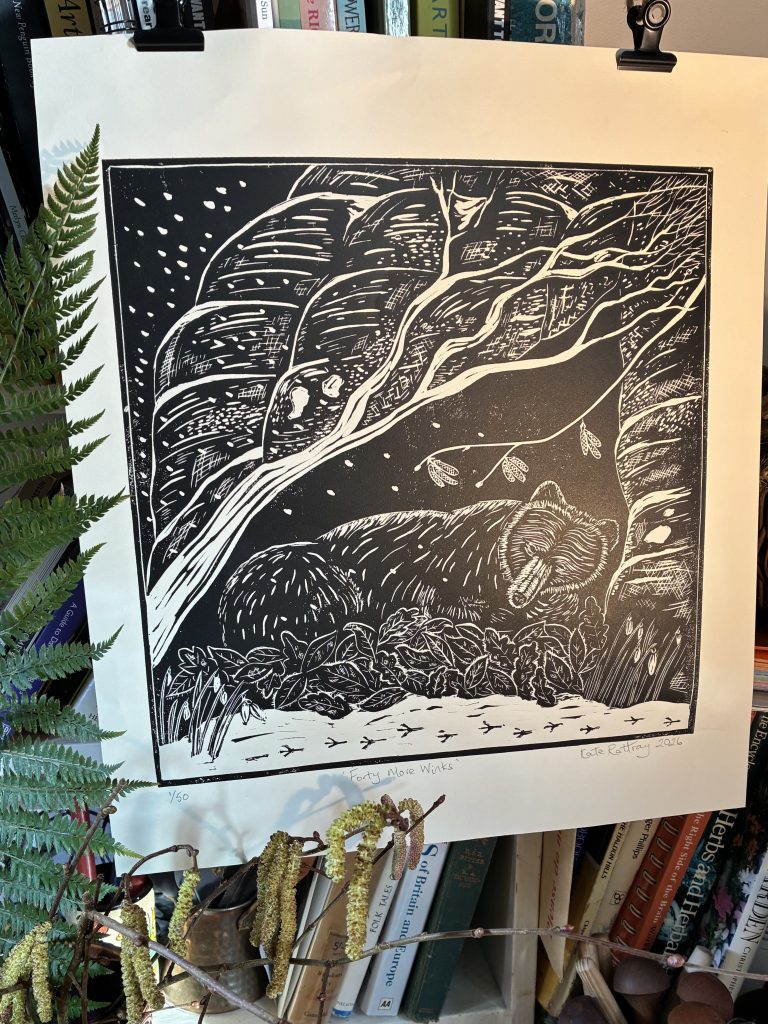
I have finished my second Lino of my winter print series. (If you missed the first one it’s here)
About 10,000 years or more ago, before the gradual shift from Neolithic hunter gatherers to Bronze Age farmers, female deities were worshipped more often than the gods that finally took their place once a patriarchal society was established.
In Celtic inspired folklore circles today the winter gods become prominent around Yuletide, in particular Herne the Hunter.
Herne was one of the leaders of the ‘Wild Hunt’ (a hunt leading animals across the sky that represented winter, war, famine and plague).
But what of the goddesses? Were any present in the wild hunt?
It turns out that yes they were indeed. As a European folktale there were several:
Roman goddess ‘Diana’, Greek ‘Artemis’, Germanic ‘Perchta’ and the Celtic ‘the Morrigan’ (who was goddess of war) to name a few.
And there was the ‘Winter Queen’, who not only rode the sky with the other riders of the storm to make winter, but who also created the landscape.
The Winter Queen is a Scottish and Irish Celtic goddess also known as the ‘Cailleach’ and ‘Beira’.
In my new lino print her long flowing hair makes the strong winds, while she blows frost into the air and makes it snow, and throws stones from her creel to make the landscape.
I’ve based the landscape on Dartmoor scenes but it could easily be the highlands of Scotland where she comes from.
If you have bought one of my prints or about to buy one, here are some tips on how to frame it. The easiest way is to take it to a reputable framers, as they should do a good job and it takes all the stress and work out of the steps required to frame your print. However this may not always be an option or in your budget. If it’s an art work on paper such as a Lino print, collage, or painting, it’s advisable to get a matt cut using mount board. This not only looks aesthetically pleasing but also acts as a barrier to keep the print from touching the glass. Without it the print might stick to the glass and there is a greater risk that dust might get into in. Do your calculations first so you can buy a frame to fit. The Matt (mount) should sit around the print allowing the edition number, name of the print, and signature to be read. The thickness of the mount should be a thick card about 1.3mm and acid free.
The top and sides of the paper surrounding the print should be the same width at about 5mm – 10mm and the bottom with the title about 10- 20mm depending on the size of the writing.
If you purchase a mount online, calculate the ‘window,’ to include the printed image and this surrounding area.
Ideally the mount will be cut to be the same size on all sides, but it can also be aesthetic to have wider sides and/or bottom. It’s your choice how wide the sides are.
Use mounting tape such as PH7-70 Acid Free Conservation Mount fixing/Frame seal. To fix the print to the mount, following the instructions on the tape box. It will be only fixed to the top of the mount. Like this on both sides at the top.
Use a piece of backing card (preferably acid free) loose behind your print (don’t stick it )
Now you are ready to pop the mounted print into a frame. Use a framing sticky tape (usually it’s sticky brown paper tape) to seal around the edges to cover the brads. Make sure it also bends round in a right angle to cover the back edge part of the frame as this will keep the dust out.
Colour
Colour of mount and frame is entirely your choice. If the print is black and white on off white paper, I find a cream or ivory mount looks good with a black frame. Coloured prints need a bit more thought. Black is a good safe option but other colours can also work well.
You can get mounts cut to size and picture frames at a framers, DIY, supermarkets or craft shops or online.
Here’s a couple of online options for mounts and/or frames.
Sometimes you can buy a frame in a supermarket including a mount that will fit just right like the ‘Divining Bird’ at the top of this post.
’Ice’ lino print is already mounted. It’s a little different in that one of the wings has escaped and is glued to the mount. I gave this print to my son Charlie who wrote the poem that inspired the print. He bought a natural wood frame online which sets off the print well and has it displayed in his boat as pictured.
The following two prints were framed by a professional framer with cream mounts and black frame.
Inspired by the witches hair lichen on Dartmoor, I delved into the internet to find out more about it. And one connection led to another. The first thing I found was its latin name which is AlectoriaSarmentosa.
When I typed the word into google I found a similar first word – Alectorus Rufa which is a red legged partridge and happens to be a bird found on the moors (although most have probably been shot over the years so they are pretty elusive)
This then led me to another ‘Alec’ word…. Alectryomancy, which is a form of divination using birds to predict the future often used by the Ancient Greeks and later the Romans and probably the Celts too. There were many ways to predict the future from birds, some involved counting birds, which direction they were flying, or how many times they called at a particular time.
For this print I drew on another way they looked for prophecies and that was the act of throwing seed over letters drawn on the ground, and letting a cockerel eat them to reveal words or arrangements of letters.
This led me to the Ogham alphabet!
Originally an early medieval Irish text carved into the ancient stones in Ireland, there have been subsequent stones found in Scotland and on Dartmoor with Celtic Ogham text inscribed .
So my red legged partridge was asked a question and she is forming the answer in Ogham.
There are different versions of this variable limited edition print available here. The one above is painted in gouache, there are other versions painted in my handmade inks. Below middle is the gouache, either side are painted using inks I have made from hawthorn berries, gorse flower petals, rowan berries, bracken and oak gall. All versions use red gouache as I couldn’t find a berry to make red. The one on the left I painted the Ogham text in brass Liquid Metal paint which is an option.
Although I have done what I can to prevent fading, the prints using handmade Dartmoor inks are not guaranteed to have lasting colour. They might even change colour! (The colours have already changed as they dried. The red hawthorn became blue (shown below in the bird throat and in the rocks) and the pinky orange rowan became green and a perfect colour for the lichen.
My day was over at Ullacombe barn where my two week studio space for Devon Open Studios was taking place and like most days I decided to blow out the cobwebs on the moor. I went to Black Hill which is the east side of Dartmoor, just a little further up from Ullacombe near Haytor.
The wind blows constantly on the moors and today was no exception. Thin tissue like sheets of wispy clouds shifted around slowly revealing blue sky and shafts of light from the watery sun. Some of the clouds were like long lengths of cotton wool that had been twisted round and round as if god was doing some diy and had dropped the screws!
As I reached the brow of the hill from the carpark, Haytor loomed ahead of me seeming to shout “Hay, I’m here, covered in grockles again.” I could see them, all milling around, like ants, climbing to the top, shouting and waving. I go up too sometimes, but here on Black Hill at the Vale it is quieter. It’s at least a mile away, possibly two and amazes me how you can hear people on the rocks if the wind is blowing this way. But today it was an east wind so it was quiet.
I followed the track north, keeping Haytor rocks on the left. Occasional larks rose from the gorse and heather and small flocks of crows pecked about on grass clearings. Sheep grazed on the new shoots of heather in the wild fire burnt gorse bushes.
And then I saw him. 20 yards away, standing in the middle of the path was a very handsome blackfaced ram with large curly horns and tousled coat of pure wildness. For a long moment our eyes met as we sized each other up. There was no way I wanted to be the bigger animal, for I was in complete awe of this magnificent creature. I would be quite happy to stand aside for him and let him make his way through. I lowered my eyes so he didn’t feel threatened as I wasn’t sure he wouldn’t run at me with those formidable horns.
I felt relief as well as disappointment as he turned his head to walk away from the path. But as he did so I noticed one of his horns was woven through with heather, gorse, hawthorn and bracken. Even though I couldn’t see him that clearly up to now, he suddenly became sharply in focus in hyperreal colour and I knew in that instant that he could be nothing less than a god.
After that encounter, I became rather obsessed with him, and I searched for him on the path whilst carving him out of lino.
But to no avail! Other sheep were there, but not him. In hindsight I wasn’t really surprised, he was an otherworldly sheep deity so would remain elusive.
I printed him with my body press (that’s my feet), gilded his halo in metal leaf and painted the moorland flora with gouache paint.
There are more versions here (gilded horns, black and white, coloured flora).
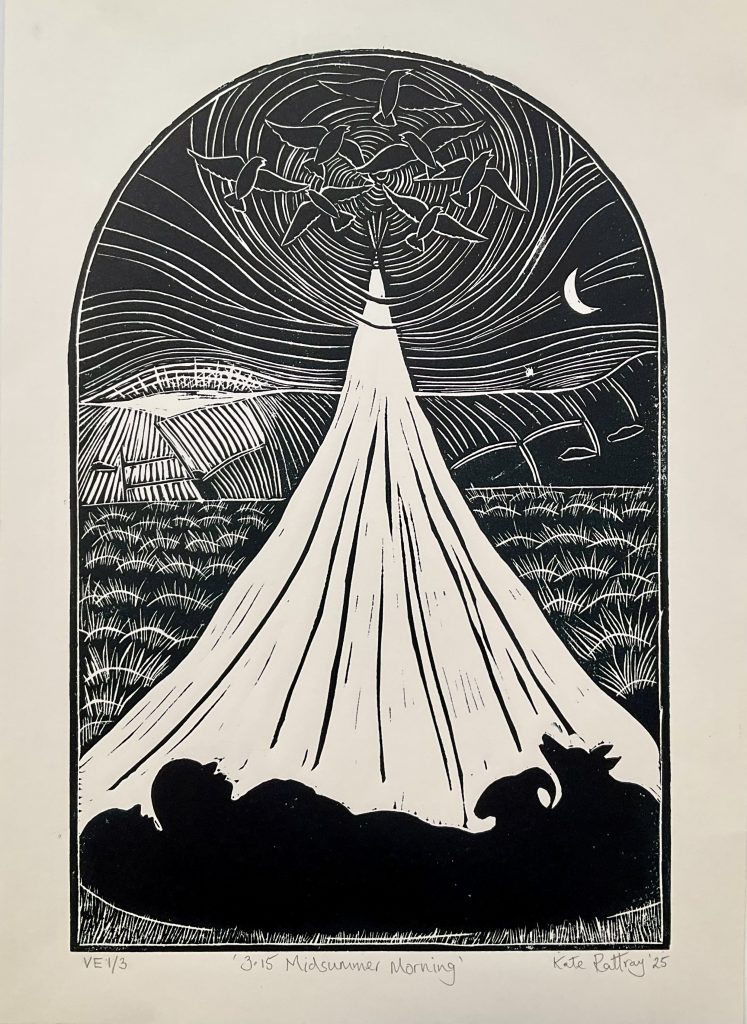
One moonlit night before sleep as I slipped into reverie, I was sure I heard the susurration of feathery wings, rippling through the midnight air outside my window. I’d been watching the swallows on the moors swooping and diving, small gulps weaving a beautiful sky dance, exuding joy from delicate wings, seemingly a pre-migration celebration . They had filled their beaks with flying insects, mosquitos, ants and crane flies, in preparation for this night, this night of melancholic harmony, this night when the wind blew from the north to help them begin their long journey. Now flying was no longer a wonderful gig in the sky under a golden orb but a serious and resolute necessity, brought about by the changing season, the squally showers cooling the air, the berries that blush on the trees, the colours of the sun caught in the bracken and leaves. And they took off one by one from their perches of hawthorn and oak leaving the moors by the light of the moon.
Will it always be ?
At this time of year
When hawthorn berries are ripe
Under darkening skies
When colours deepen and shadow
And trees bend and bow their heads
To the calling breeze, and mizzle wet branches droop in
Lonely Mist,
Will it always be that the wind and cooler rain,
Tell the swallows to gather and fly
And wings brush leaves through trees that wail and cry
This year I won an emerging artist bursary award from Devon Open Studios. Have a look at the bursary winners here.
I also won the Joanna Radford prize which was a cash prize to help me purchase some more (much needed) materials.
Here I am emerging from the bushes!
I will be exhibiting my work with Moorland Makers, a diverse group of artists and crafters from Dartmoor, for Devon Open Studios which starts on 6th September and continues until 21st September. We will be in the barn at Ullacombe Farm, Haytor Road, Bovey Tracey. Details here
I will have all my lino prints with me, including some new work that takes a slightly different form in that all the materials were foraged from Dartmoor.
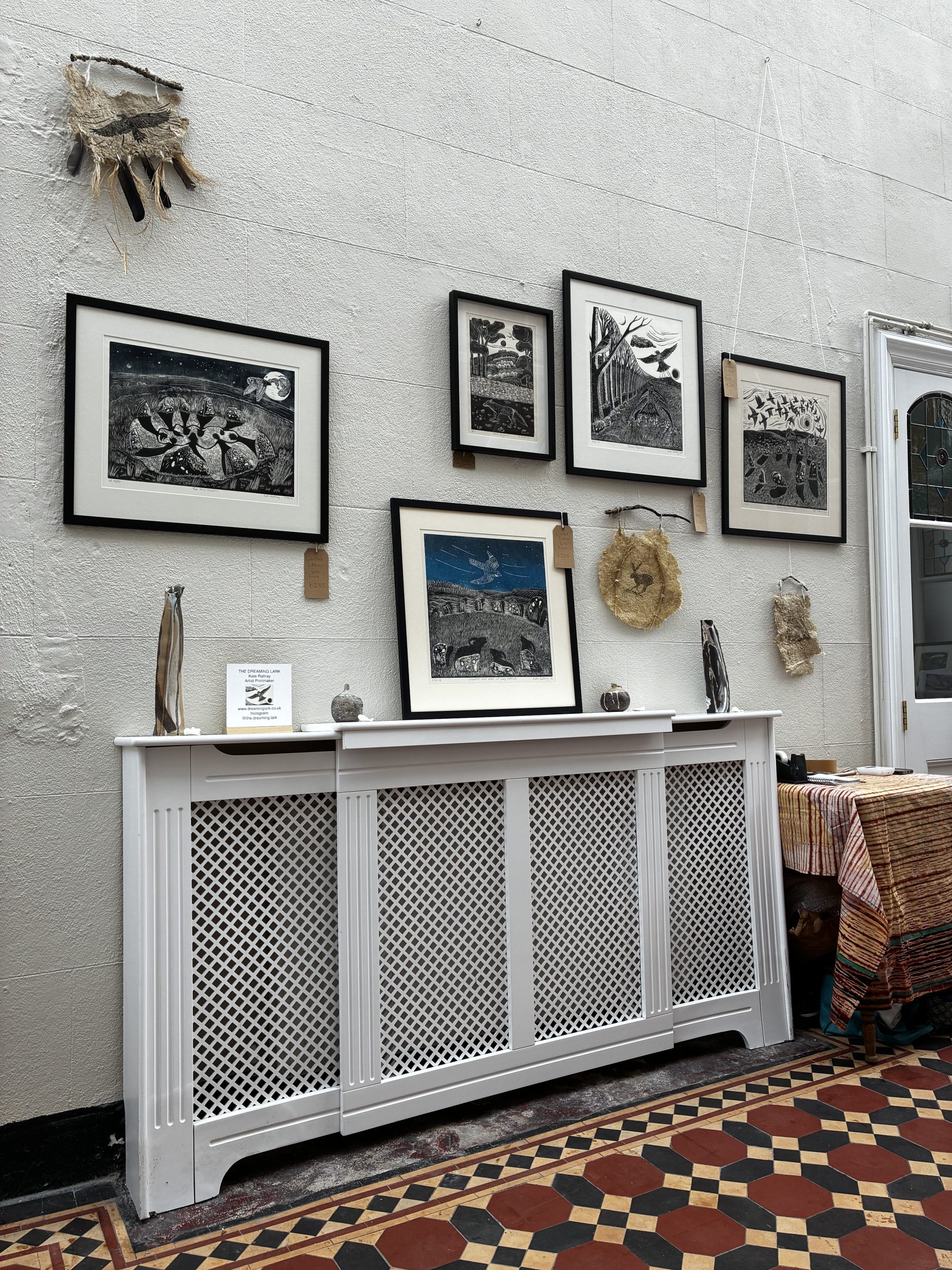
So for instance, in this raven piece, I made the paper from the loose dry moorland grass, (which is also hanging in tufts next to the moorland corvid feathers) and sourced charcoal from Yarner woods to make the ink for the lino print. Sheeps wool from Fernworthy is twisted to make the strings to hang the piece from a bit of wood picked up on one of the many walks I have on the moors.
I’m working with a sense of place, an eco mindset, a quiet form of activism which questions consumerism, and an idea that keeps tapping me on the back… What will you make art with once the world runs down and out? (I’m assuming I’ll still be here and the moors will be too!) The first priority will be to find food and the second to make art.
Of course I know I’d probably be more interested in surviving the onslaught of lawlessness and chaos that would ensue, dodging the Mad Maxes and probably becoming one myself with sticks and stones at the ready! I will probably have to quickly learn how to shoot a gun and kill the unraveled nutters if they didn’t get me first. I really hope I don’t have to kill animals, I’d like to think I’d survive on berries and nuts, but come the winter…